In December 2022 AMD launched the RX 7900 XTX, with 24 GB of memory and a $999 gaming-card price, yet running language models on one was the slower, fussier option for most of the years since. That reputation is now partly out of date. For text generation on a mixture-of-experts model, our estimate for a used 7900 XTX matches within about 4% of an RTX 3090. The newer RX 9000 cards reach three quarters of their NVIDIA rivals' speed on that model, by our estimate. The remaining performance gap is in dense models and long prompts. Software smoothness varies, based on the operating system and card. Intel's Arc Pro cards have the most memory per dollar at list price but the least finished software. Our choice for MoE models would be AMD, and we would select Intel only when 32 GB matters more than speed or an easy setup.
Key takeaways
- For mixture-of-experts models, our estimate puts the used RX 7900 XTX at 96% of an RTX 3090's speed on Qwen3.6 35B A3B. AMD is nearly there.
- On dense models, NVIDIA is still ahead. In the 16 GB class, our estimate has the RTX 5070 Ti about 1.5 times as fast as the RX 9070.
- AMD speed depends as much on the backend as on the card. On one owner's RX 9070 XT, Vulkan was faster than ROCm on short prompts, but three times slower at 131K tokens.
- AMD lists these cards for ROCm on Windows 11 now, although Ollama's Windows ROCm list covers only the RX 7000 series.
- Intel's 32 GB Arc Pro B70 has a list price of $949. It runs a 27B model at about a quarter of an RTX 5090's speed, by our estimate.
Cards that ended up doing a different job
These cards were never designed for chatbots. The 7900 XTX was the gaming flagship in AMD's 2022 range, and AMD's November 2022 announcement was about 4K gaming and chiplet design. The 24 GB of memory at 960 GB/s has held up well. Text generation is limited by memory bandwidth, and this is slightly more than a 3090 has.
The RX 9070 XT and RX 9070 became available in March 2025 for $599 and $549, with 16 GB each. AMD's launch release mentioned "second-generation AI accelerators", but the AI it promoted was mostly FSR 4 upscaling in games. The Radeon AI PRO R9700 came out that July for $1,299, with 32 GB on a workstation board using the same RDNA 4 design (gfx1201 in AMD's ROCm tables).
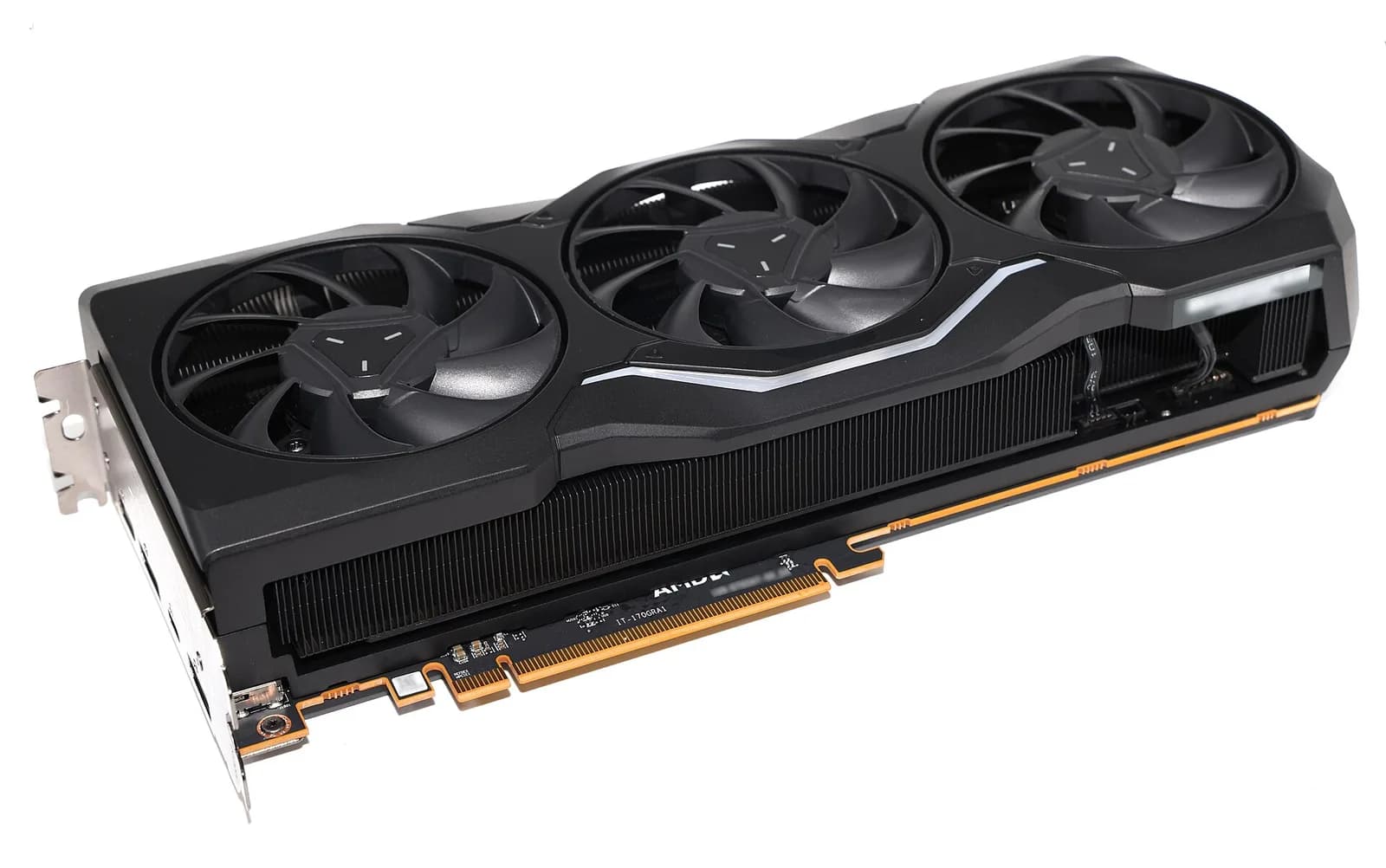
A 2022 gaming flagship whose 24 GB made it the default AMD card for local models
Intel, on the other hand, comes at it from the other direction. At Computex 2025, Intel showed the 24 GB Arc Pro B60 and Project Battlematrix, a workstation design with up to eight B60s and 192 GB of memory for inference. The 32 GB Arc Pro B70 became available in March 2026 for $949. StorageReview liked the hardware, but wrote: "The biggest challenge facing the Arc Pro B70 isn't the silicon; it's the software ecosystem surrounding it."
Where AMD caught up: mixture-of-experts models
Because a mixture-of-experts (MoE) model reads only a few billion of its parameters per token, it runs several times faster than a dense model of the same size. The AMD and NVIDIA cards are close in our estimates for these models, much closer than they are for dense models.
- AMD
- NVIDIA
RX 9070 vs RTX 5070 Ti, 9B dense
AMD60.4NVIDIA91.6RX 9070 vs RTX 5070 Ti, 35B MoE
AMD131.9NVIDIA173.9RX 7900 XTX vs RTX 3090, 9B dense
AMD90.6NVIDIA95.7RX 7900 XTX vs RTX 3090, 35B MoE
AMD138.3NVIDIA143.6
| Item | AMD | NVIDIA |
|---|---|---|
| RX 9070 vs RTX 5070 Ti, 9B dense | 60.4 | 91.6 |
| RX 9070 vs RTX 5070 Ti, 35B MoE | 131.9 | 173.9 |
| RX 7900 XTX vs RTX 3090, 9B dense | 90.6 | 95.7 |
| RX 7900 XTX vs RTX 3090, 35B MoE | 138.3 | 143.6 |
Our estimated RX 9070 speed is two thirds of the RTX 5070 Ti's for the dense model, and three quarters for the MoE model. The AMD card at $800 costs less per token on MoE models than the $1,170 NVIDIA card (new, observed 2026-10-13).
Until 15 November our own estimates were the other way round. Our estimate for the 7900 XTX was about half a 3090's speed on this MoE model because it was based on a single AMD ROCm run from 2025. With the newer public RX 9070 XT runs under ROCm and Vulkan showing no such penalty, we re-fitted the AMD figures and estimated the 7900 XTX at 138.3 tok/s. If a guide earlier this year said AMD falls apart on MoE models, that was the evidence it was based on.
Most of the models our Score ranks highest for a 16 GB card are small dense ones, but the one MoE model among them is the fastest in our estimates. For Qwen3.8 27B, an RX 9070 is large enough only at 3-bit.
| # | Model | Speed on RX 9070 | llmrun Score | Quant · VRAM |
|---|---|---|---|---|
| 1 | Qwen3.5 9BAlibabaHow to run → Q4_K_M · 6.6 GB · 60.4 t/s | 60.4 tok/s | Q4_K_M · 6.6 GB | |
| 2 | Qwen3.5 4BAlibaba Q4_K_M · 3.4 GB · 118 t/s | 118 tok/s | Q4_K_M · 3.4 GB | |
| 3 | GPT OSS 20BOpenAI Q4_K_M · 13.1 GB · 124 t/s | 124 tok/s | Q4_K_M · 13.1 GB | |
| 4 | Phi 4Microsoft Q4_K_M · 12.5 GB · 40.3 t/s | 40.3 tok/s | Q4_K_M · 12.5 GB |
Where NVIDIA still leads: dense models and long prompts
The RTX 5070 Ti is about 1.5 times as fast as the RX 9070 on dense models, by our estimate. The gap is easy to live with on small models, but harder on big ones. For Qwen3.8 27B at 3-bit, the RX 9070 has an estimated speed of 25.6 tok/s, still faster than anyone reads; the RX 9060 XT has half the bandwidth and half that estimated speed.
Going by the public measurements, that might be a conservative estimate for AMD on dense models. For Llama 2 7B, the RX 9070 XT has about 137 tok/s on llama.cpp's Vulkan scoreboard, which is roughly three quarters of the RTX 5070 Ti's speed on the CUDA scoreboard. The same Vulkan scoreboard has the 7900 XTX ahead of the 3090 on that model, rather than the 5% behind in our estimate. A good AMD backend can do better than the efficiency figure we use.
As for prompt processing, it depends on raw compute rather than memory speed. Everything you send has to be processed before the first word appears. In a chat you will not notice. Paste a long file into a coding agent and you will.
- RTX 40903.1
- Radeon AI PRO R97005.4
- Arc Pro B706.9
- RTX 30907.1
- RX 7900 XTX8.4
- Arc Pro B6012.8
| Item | seconds to first token, 4,000-token prompt, Qwen3.8 27B Q4_K_M, estimated |
|---|---|
| RTX 4090 | 3.1 |
| Radeon AI PRO R9700 | 5.4 |
| Arc Pro B70 | 6.9 |
| RTX 3090 | 7.1 |
| RX 7900 XTX | 8.4 |
| Arc Pro B60 | 12.8 |
The 7900 XTX, in our estimate, is the slowest prompt reader of the three 24 GB gaming cards, behind even the 3090. The 3090 on the Vulkan scoreboard is about 1.25 times as fast for a 512-token prompt. The newer RDNA 4 chip in the R9700 does much better by our estimate. Long prompts are sent again on every turn, so the prompt-processing time needs to be considered for agent work.
On AMD, the backend matters as much as the card
For AMD owners, the two llama.cpp backends are ROCm (AMD's own compute stack, called HIP in llama.cpp) and Vulkan (the graphics API every driver ships), while NVIDIA owners have CUDA and little else to think about. The choice can be worth more than a card upgrade.
The RX 9070 XT has about 137 tok/s on Vulkan, compared to about 101 on the ROCm scoreboard. One owner used the same RX 9070 XT and llama.cpp build for both backends in kr4ckhe4d's benchmarks (August 2026), but found the results reversed at long context. With gpt-oss-20b, Vulkan generated about 22% faster than ROCm on a short prompt, while its rate at 131K tokens of context fell to 22 tok/s and ROCm held 70. ROCm was faster from the beginning on the dense Qwen3.8 27B. The owner moved to ROCm.
There is no single answer to "ROCm or Vulkan". Vulkan is easy to set up and often faster for short chats. From the evidence we could find, ROCm is worth the setup work for long contexts and dense models.
What the documentation promises, on Linux and Windows
There is now Windows support on paper. According to AMD's HIP SDK for Windows, the RX 9070, RX 9070 XT, Radeon AI PRO R9700 and RX 7900 XTX are supported on Windows 11. Ready-made Windows builds for ROCm, Vulkan and Intel's SYCL are now available from llama.cpp alongside CUDA. AMD's Windows PyTorch matrix still says "the entire ROCm stack is not yet supported on Windows."
The following list is from each project's own pages, read on 2026-11-16:
| Route | Linux | Windows |
|---|---|---|
| AMD ROCm (Linux, Windows HIP SDK) | RX 9070, 9070 XT, 9060 XT, 7900 XTX, AI PRO R9700; Ubuntu 24.04.4 and 22.04.5, RHEL 10.1 and 9.7 | RX 9070, 9070 XT, 7900 XTX, AI PRO R9700 on Windows 11 |
| Ollama, ROCm | RX 9000 and 7000 series, Radeon AI PRO (ROCm v7 driver) | RX 7000 series only |
| Ollama, Vulkan | on by default; Intel GPUs go this way | on by default; the route for RX 9000 cards |
| llama.cpp prebuilt releases | ROCm, Vulkan, SYCL | ROCm, Vulkan, SYCL |
| Intel llm-scaler (vLLM in Docker) | Arc Pro B60 and B70 | not listed |
On Windows, Ollama uses Vulkan by default for an RX 9000 without any setup. For ROCm, go to llama.cpp or another tool built on it. With a 7900 XTX, Ollama has ROCm on both systems.
Intel: cheap memory, unfinished software
The Arc Pro cards offer the most memory for the money at list prices.
There is a trade-off in speed. The B70's memory bandwidth is below even the RX 9070's, at 608 GB/s. Our speed estimate for the B70 on Qwen3.8 27B is about 17.5 tok/s, about half the rate of a 3090. The B70 is a little behind an RX 9070 XT on a 7B model on the Vulkan scoreboard, which agrees with our figures. The B60 is slower again by our estimate, and the slowest of the cards in the chart above on a long prompt.
But the bigger problem is the software. The verified cards on llama.cpp's SYCL page still include the Arc A770, A750, A730M and B580 but no Arc Pro card, although fused MoE kernels were added in the spring 2026 changelog. Intel cards use Vulkan with Ollama, though no Intel card is named there. The B60 and B70 have Intel's llm-scaler, a set of vLLM Docker images, which StorageReview called "still a beta release at best". Our Intel MoE figures are based on a single report and are the least certain estimates in this article.
The Arc Pro B60 Dual has two B60s on one board and a $1,200 list price. Its 48 GB comes as two 24 GB GPUs, and a bigger model needs software that splits it across both. Our catalogue has Llama 3.3 70B at IQ4_XS fitting the pair at an estimated 5.5 tok/s, assuming the split works well. We found no published runs on this board to confirm that.
32 GB without buying an RTX 5090
The R9700 and B70 give you 32 GB on one GPU for the lowest prices. Their list prices are $1,299 and $949, compared with a new RTX 5090 at $6,250 in our data on 2026-11-14. The estimated speed gap is about as wide as the price gap.
| Hardware | Speed | Power W |
|---|---|---|
| AI PRO R9700 | 22 | 300 |
| Arc Pro B70 | 18 | 230 (best) |
| RTX 5090 | 67 (best) | 575 |
- RTX 509067
- tok/s · higher is better
- AI PRO R9700300
- Arc Pro B70230
- RTX 5090575
- W · lower is better
There is room for more context with the extra 8 GB over a 24 GB card, rather than a bigger class of model. For Llama 3.3 70B these cards are large enough only at IQ2_M, a 2-bit quant that we grade D, while Q4_K_M needs 51.3 GB.
The list price has had little to do with the selling price this year. The median listing for the R9700 in our price data was $1,301 in May and $1,983 in October, well above the $1,299 list price. B70s were already selling above $1,100 in July according to StorageReview, which put that down to the memory shortage. Used RTX 3090 prices have nearly doubled over the same months in our data.
- Used, Oct 2026
- $1,983
- Used, Jan 2026
- $1,540
- Launch price (MSRP)
- $1,299
| Month | New | Used |
|---|---|---|
| Jan 2026 | — | $1,540 |
| Feb 2026 | — | $1,499 |
| Mar 2026 | — | $1,618 |
| Apr 2026 | — | $1,331 |
| May 2026 | — | $1,301 |
| Jun 2026 | — | $1,326 |
| Jul 2026 | — | $1,320 |
| Aug 2026 | — | $1,540 |
| Sep 2026 | — | $1,780 |
| Oct 2026 | — | $1,983 |
Verdict
Our read
Our choice for MoE models would be AMD. While setting up Intel's software takes time, the memory is cheap at list price.
Good for
- The RX 9070 for MoE models on a 16 GB budget, at a lower cost per token than an RTX 5070 Ti by our estimate
- The RX 7900 XTX for chat, with 24 GB at a lower used price than an RTX 3090
- People who need 32 GB on one GPU and accept lower speed and some setup work
Not for
- Long-prompt agent work, where the 7900 XTX takes more than twice as long as a 4090 to start answering by our estimate
- Anyone who wants CUDA-only tools to work without fuss
- People with an RX 9000 card who want ROCm in Ollama on Windows